Showing posts with label hardware. Show all posts

Friday, March 22, 2013

Getting the Grade


http://www.ryancompanies.com/

I attended one of my favorite customer’s 75th anniversary party last week. While mingling I met an architect and the conversation drifted to hardware.  As always when I meet an architect the question I ask is what frustrates you most about hardware?

In this case the answer was the different grades of locksets. The architect went on to explain that he primarily uses mortise locksets but he knows they are the "top of the line" and sometimes his clients prefer something less so.
 
As I was explaining the different grades and how he might be able to value engineer I thought this information might make a good blog post.  Aren’t bloggers always thinking that!

The Builder’s Hardware Association (BHMA) and the American National Standards Institute (ANSI) developed grading requirements for cylindrical and mortise locksets to ensure quality and performance from builders hardware.

Strength, performance, and construction are all included in defining the three grades of locks.

Hager Grade 1 3400 Lock
Grade 1 is the highest performing rating. A Grade 1 lock must be capable of performing through 800,000 latches and unlatches without failure. It must withstand 700 lbs of force per inch for lever locks.

Grade 2 is a medium grade and capable of operating through 400,000 cycles while withstanding 450 lbs of force per inch for lever locks.

Grade 3 is the lowest grade. It must operate for a minimum of 200,000 cycles and withstand 225 lbs of force per inch for lever locks.

In my opinion how to choose what Grade of lock is appropriate is less about the building and more about each individual door opening. After reviewing specifications for 19 years I know Grade 1 is the most popular choice.  These locks should be used on exterior openings that don’t require an exit device and any interior opening that gets heavy traffic but there are other less used openings in a building that a Grade 2 lock may be used and in turn save the owner money. I haven’t yet used a Grade 3 lock in a commercial application.

A couple of examples:

Locksets at schools get a lot of abuse! Every exterior opening should have Grade 1 hardware both for security and abuse factors.  Any interior openings at middle and high school that kids use should also have Grade 1 hardware. What kids can do to a lock never ceases to amaze me. However at a single bathroom in the teacher’s lounge a Grade 2 might be acceptable.  

In another scenario a Grade 1 lock at the entry doors into a tenant space in an office building is a smart choice for security. The offices, bathrooms and storage rooms, depending upon the tenant employee/visitor numbers, a Grade 2 would be a good choice.  

Manufacturers typically offer the same lever & rose styles for both Grade 1 and 2 locksets so all the locksets will be uniformed even when mixing different Grades.

There is a lot more information available but hopefully this provides a basic outline for you.

Thanks!

Friday, July 27, 2012

Always learning

Hillsborough County schools open in 3 weeks.  I don't have children but I know this because I provided doors, frames and hardware to two Charter Schools that are almost at the end of the construction process.   Most of my work is done except for the occasional phone call from the job superintendent about something that has gone missing.  Happens at the end of every project.  


Both jobs went smoothly but one ended up being a big learning lesson for me and I wanted to share it in case anyone else runs into this. 


I was bidding 4 schools at one time but there were only two floor plan prototypes.  All four projects were being built by the same General Contractor, who is one of my favorite companies to work with.  I had been part of two other charter school builds the previous year so everything was pretty standard.  I was awarded two of the schools and they happened to have different floor plans.  Both were being built at the same time so I wanted to make sure I kept all the paperwork and communication separate.  I didn't want maple doors showing up at the school that was supposed to get birch!


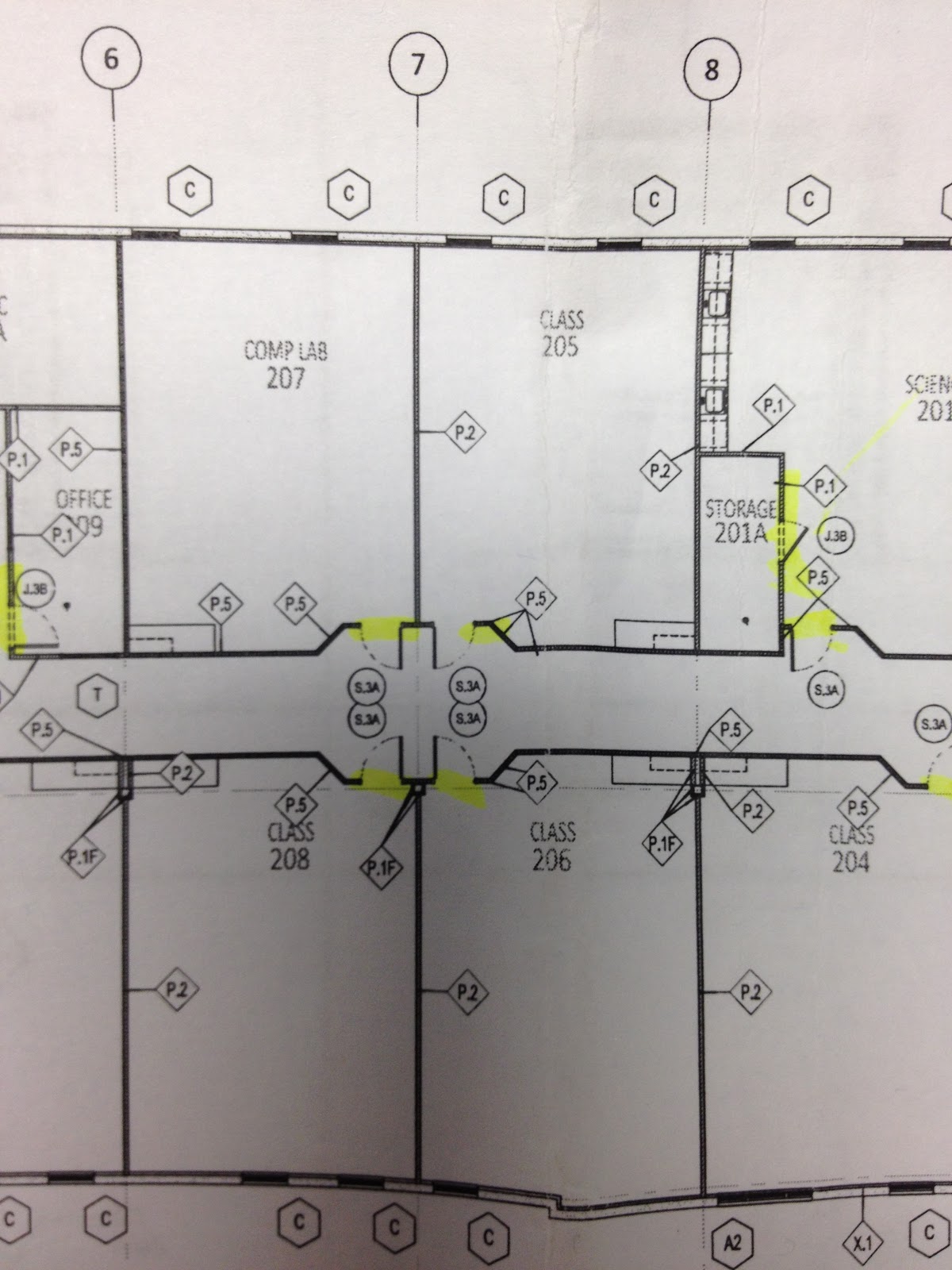
All the hollow metal frames, wood doors and hardware had been delivered and installed at one of the schools when I had a call from the project manager. They were seeing an potential issue and wanted to see if I could come up with a solution.  The issue was that the corridor doors were designed to open almost back to back leaving a small wall between them.  

It was impossible to use a wall or floor stop to stop the doors from hitting one another when opened.  And lets be honest - kids barrel through classroom doors when they hear the bell. (Is there even a bell anymore?).  The architect didn't notice it during the design process, the GC didn't notice it when reviewing the plans and I didn't catch it either.  The fix was relatively easy.  I supplied stop closer arms for all the classroom doors and this solved the issue. 


In my humble opinion this wasn't any one person's fault and hopefully all of us involved learned a lesson that will be applied to future projects.  I am glad I was able to come up with a solution that didn't cost a lot in either time or expense.


One thing about this job is I am always learning something new!

Thursday, July 7, 2011

It’s all in the timing

In today’s marketplace it is a delicate balance when material is ordered for a project, especially hardware.  I don’t want to bring it in too early and have it sit here but I want to make sure that I have time enough to tag each piece with the door number and react if something is incorrect.  The most important balance I try to achieve is to bring the material in the same month I am invoicing the customer.

Case in point: I ordered hardware for 107 openings and asked for it to be shipped on July 8th.  Two pallets of hardware showed up on July 1 and the invoice was dated June 28th which was the ship date.  I was not a happy camper and neither was my boss.  My vendor gets the big billing in June but we don’t.  I am not sure how to discuss it either because this particular vendor is in my top 5 “go to” vendor list.

I discussed this issue with a few cohorts and one said she absolutely picks up the phone and calls the vendor to express her displeasure.  The other was more laid back and figures it all washes out in the end.

What I ended up doing is calling my outside representative and discussing the matter with.  He offered me a 30 day extension due date which worked for me. 

Do you have a discussion with your vendors or figure it all washes out in the end?


Friday, May 13, 2011

Can you have it both ways?


An old closer

I have read a lot of finish hardware specifications and written a fair amount of finish hardware schedules in my 16 years in this industry.  I have always been curious why some spec writers use the word closure and some closer.  Personally I have always used closer probably since that is the term the manufacturers call their devices and that is what I sell.   Recently I came across a spec that used closure and decided to do a bit of investigating.

To the dictionary…..

  Closure..noun…1.  the act of closing  2. The state of being closed  3.  Something that closes shut.

  Closer …noun    1.  A person or thing that closes.

Based on those definitions I interpret that the actual device is a closer but the physical action is closure.  But wouldn’t that make closure a verb? Based on my interpretation I would assume (yes I used the word) that if the specification was written in the long format using closure would be appropriate but if listing out each individual hardware item closer should be used.

Now this is Friday and my brain is a little fried from the week and let’s face it grammar isn’t my strong suit, so please feel free to correct me in the comments.

Thursday, April 21, 2011

The Right Fit

I am not an every size project fits me type salesperson.  
http://www.toonpool.com/

It seems in today’s tough economy distributors are bidding on any and every project that comes their way.  While I understand the knee jerk reaction I personally don’t feel it is the best approach.   In order to provide the best experience for a customer I think both size and project type need to be considered.

A large distributor that employs estimators, salespeople, detailers, project managers and warehouse staff should be able to excel at a project with 600 openings.  That same project would likely cause a nervous breakdown to a small distributor where the salesperson wears each of those hats at every moment.   Another reason to really spend time making sure a project is the right fit, don’t over extend!  Financially 600 openings = 600 frames and doors, 1800 hinges and so much more, that is a lot of monetary output with payment running at 45-60 days. 

Personally I like to keep my customer service level high so I always get a phone call for the re-order.  You know the next job the boss is always asking about.  My own rule of 100 and under works best for me.  I typically don’t bid a project with over 100 openings unless it is for a very good customer and the count is close. 


http://www.rosecottagegardenandfarm.com/

I just closed a 105 opening project which makes me excited and terrified all at the same time.  With my existing work load plus the new project I won’t bid a lot of work to make sure I meet the material and time requirements of the jobs.  In the meantime I will balance a lot of hats and be counting a lot of hinges!